
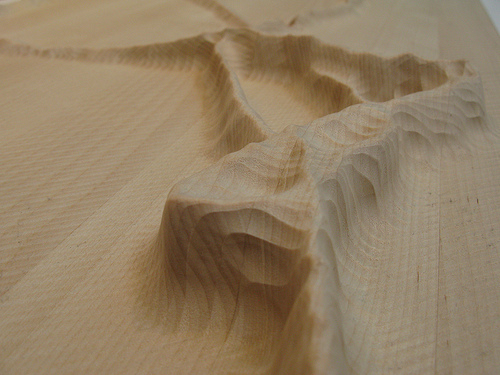
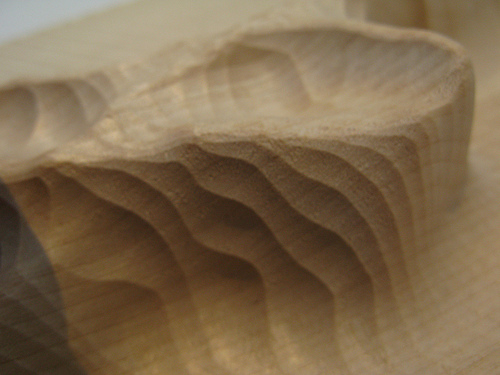
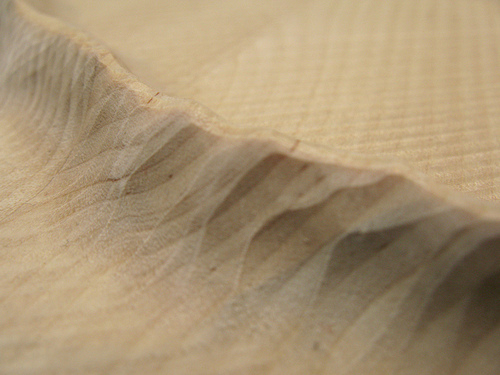
Windcuts [flickr.com] consists of various experiments that turn quantitative sensor data into visually compelling physical instantiations. Wind movement measurement data, such as wind direction, velocity and temperature, was used as the foundation to generate a 3D form, which was then physically drilled out of a piece of wood.
The direction of the physical line corresponds with the direction of the wind. The width and speed of movement reflects the wind speed. The temperature is mapped unto the height. The materials ‘surface plateau’ height represents zero degrees Celsius. So when the shape dips below the surface, it means the wind’s below zero degrees.
Images and articles first seen on el conTEXTO
Showing posts with label art. Show all posts
Showing posts with label art. Show all posts
Thursday, May 6, 2010
Windcuts


Sunday, January 24, 2010
Dot. Dot. Polka dot.

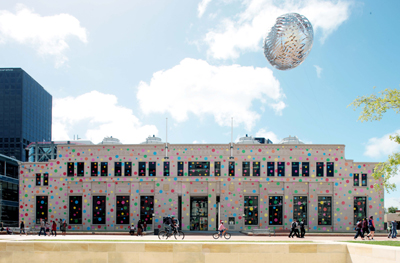
Polka dots are back in 'fashion'. Not that they were ever out. While polka dots are ancient, they first became common on clothing in the late nineteenth century in Britain. At the same time polka music was extremely popular and the name was also applied to the pattern, despite no real connection between them. The polka dot also appears in popular music. Remember "Itsy Bitsy Teenie Weenie Yellow Polka Dot Bikini" by Brian Hyland? Before that however, "Polka Dots and Moonbeams" was Frank Sinatra's first hit recorded with the Tommy Dorsey Orchestra, published in 1940.
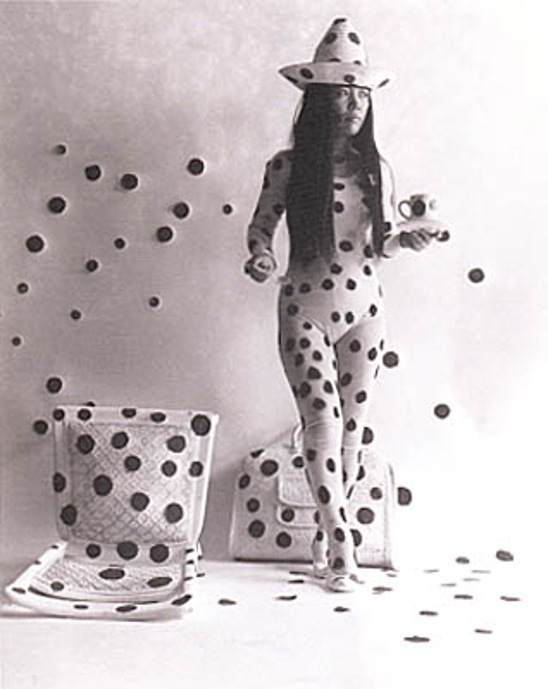
Polka dots have been also the 'thing' that marked the life and work by Yayoi Kusama, japanese avantgarde artist that suffered since childhood from hallucinations and started to cover surfaces with the polka dots. There was a time when she was as well-known as Andy Warhol among admirers of Pop Art. Acknowledged as a progenitor of Minimalism, Kusama made headlines for street performances in which she painted polka dots on nude men and women. But Kusama was largely forgotten by the art world after she returned to Japan in 1973, suffering from obsessive-compulsive disorder. She was committed to a mental institution, where she remains to this day.

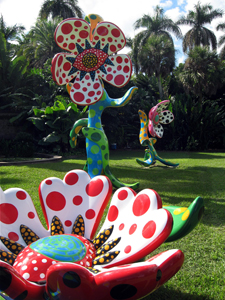
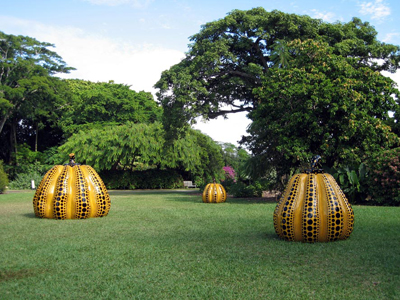
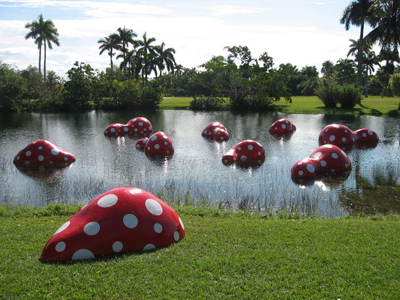
Kusama’s neglect by art history has been redressed in a traveling retrospective of her seminal 1960s work. When the retrospective was on view in New York’s Museum of Modern Art, shock waves of recognition went through the art world. Lately, her work has been traveling around the world and you can see her work here: Matsumoto City Museum of Art, Nagano, Japan; CITY GALLERY WELLINGTON, New Zealand; Padiglione d'Arte Contemporanea, Milan; Fairchild Tropical Botanic Garden, Miami; and The National Museum of Art, Osaka.

She also collaborated with Japanese mobile provider iida and created a limited art edition mobile phone.

Monday, January 18, 2010
First Spring; a movie by Prada + Yang Fudong

Inspired by the Chinese adage that "the whole year's work depends on a good start in spring", this bold and beautiful film (9,17 mins) represents an exciting new direction for Prada's visual communications at the start of this decade.
Featuring young men gathered in Shanghai, dressed in Prada menswear, the black and white film portrays a timeless, dreamlike realm where anything is possible.
"First Spring" is Prada's latest collaboration with pioneering Chinese artist Yang Fudong.
Picture in the movie is subtle and sublime, quiet but meaningful:


Friday, December 18, 2009
Ai WeiWei does Barcelona in a pool full of milk
 The Mies van der Rohe Pavilion is the object of an intervention that reflects upon the use of buildings and how we perceive them as unique and inalterable spaces.
Artist Ai Weiwei, one of the most distinguished figures of Chinese modern art and also one of the most controversial, has filled the swimming pools of the Pavilion with two very habitual elements of our daily life, but totally alien to architecture: milk for the outside swimming pool and coffee for the indoor pool. The intervention is a part of a series of installations by several artists and architects from around the world. The performances are short and propose a new approach to the pavilion's architecture. The installations programme adds a new type of activity in the city based on the exceptional spaces of buildings. Japanese architects Kazuyo Sejima and Ryue Nishizawa, from the SANAA studio, and Enric Miralles and Benedetta Tagliabue have carried out installations in the pavilions Antoni Muntadas, Jeff Wall and Dennis Adams among others.
To see more photos of the artist in action @ the pavilion click here.
For LIVE images from the pavilion (via webcam), click here.
Thursday, June 25, 2009
your own collab with Joshua Davis
Here at LA76 are big fans of Joshua Davis for several different reasons. His work as an early Flash pioneer with Praystation and he was a one of the first people to release their Flash code as open source so everyone could learn and grow from what he was doing. Some people say is great to see him speak live (we haven't got the chance) because of his energy and that fantastic fight between jet lag and Red Bull for control of his brain (here talking at OFFF Portugal). We not only love the look but because of play between the left brain/right brain intersection that happen when you bring art, technology and interactive together like this.
This week he took his art into a new direction with the launch of the Reflect iPhone application.
 You start in Designer mode where you can choose one of his six distinct visual systems and one of ten color palettes. Then it gets really interesting because you collaborate with the application to create the final work of art.You draw on the canvas to control where symbols are placed but the application uses dynamic abstraction to select the symbols and colors so each piece is always unique. This is the type of left brain/right brain intersection we love. When you are happy with you creation you can save it to your photo gallery for various uses or put in into the Kaleidoscope view within the application.
Saturday, April 18, 2009
Gangs of Kabukicho by Watanabe Katsumi

I found the post about Watanabe Katsumi on The Moment blog, really liked the imagery and wanted to share it with you...
Despite recent attempts at gentrification, Kabukicho in the East Shinjuku section of Tokyo remains the city’s seedy underbelly. In the event that it ultimately goes the sanitized way of 42nd Street, the photographer Watanabe Katsumi’s book, “Gangs of Kabukicho” (D.A.P.), is a divinely decadent chronicle of the area’s hostess-bar and yakuza heyday.
Watanabe, who died of stomach cancer in 2006, was an itinerant who made a measly living — during one low point he gave up photography altogether and sold sweet potatoes on the sidewalks — shooting the dissolute denizens of Kabukicho, including the “blue-light” district’s many drag queens, prostitutes and gangsters. (Watanabe would photograph his subjects and return the following evening to deliver the prints, for which he received a small fee.)
Most of the black and white photographs in “Gangs of Kabukicho” were originally printed in a tiny 1972 self-published book and later shown in Watanabe’s only exhibition, in 1986. These effortlessly stylish images caught the attention of the New York gallerist Andrew Roth, who flew to Tokyo to meet with the photographer weeks before his death. “Watanabe was not well known at all,” says Roth, who is now the caretaker of the Watanabe estate, “but, by their own admission, Japanese photography stars like Keizo Kitajima, Nobuyoshi Araki and Daido Moriyama are all indebted to him. Hopefully this book shows that Japanese street photography did not start with the current interest in Harajuku and gives Watanabe the recognition he did not enjoy in life.”
“Gangs of Kabukicho” by Watanabe Katsumi is distributed by D.A.P. and is available at artbook.com and amazon.com.
Subscribe to:
Posts (Atom)


 Posts
Posts


